The Great Wildebeest Migration ,one of the Seven New Wonders of the World
Everything a Kenyan traveller needs to plan an unforgettable season watching wildebeest thunder across the Mara plains.
Every year, tour operators in Nairobi and Arusha get the same question on repeat: "When exactly should I book my safari to see the migration?" The honest answer frustrates people who want a fixed date. There isn't one. The Great Wildebeest Migration is not a scheduled event with a start time. It's a survival response, roughly 1.3 million wildebeest, alongside hundreds of thousands of zebras and gazelles, chasing rain and grass in a loop so consistent it has run for thousands of years, yet so weather-dependent that no calendar can pin it down precisely.
That tension, between pattern and unpredictability, is what makes this migration one of the genuine Seven New Wonders of the World. It isn't a monument standing still for you to photograph. It's alive, it moves, and it occasionally kills the very animals participating in it by the tens of thousands.
What Is the Great Wildebeest Migration?
Strip away the marketing language you see on safari brochures, and the migration is simply a circular movement of grazing animals across the Serengeti-Mara ecosystem, following rainfall and grass availability. Wildebeest are the dominant species by far, but they don't travel alone. Roughly 200,000 to 250,000 zebras and around 400,000 Thomson's gazelles move alongside them, according to figures compiled by Africa Safari Expeditions. Zebras actually walk ahead of the wildebeest herds much of the time, cropping the tall, coarse grass down to a height that suits wildebeest grazing patterns, which then leaves short tender shoots for the gazelles that follow, a succession pattern documented by Asilia Africa. It's an oddly efficient division of labor that nobody designed. Nature just settled on it.
Why Do Wildebeest Migrate Every Year?
Grass, plainly put, and water. Wildebeest are not particularly smart animals individually, but as a herd they respond with startling precision to rainfall patterns across the plains. When the grass in one region dries out or gets grazed down, the herds move toward wherever the rain has fallen recently, because that's where new growth appears. This isn't a leisurely stroll. It's constant, restless movement driven by hunger and thirst, spanning over 1,000 kilometers annually.
How Many Animals Take Part in the Migration?
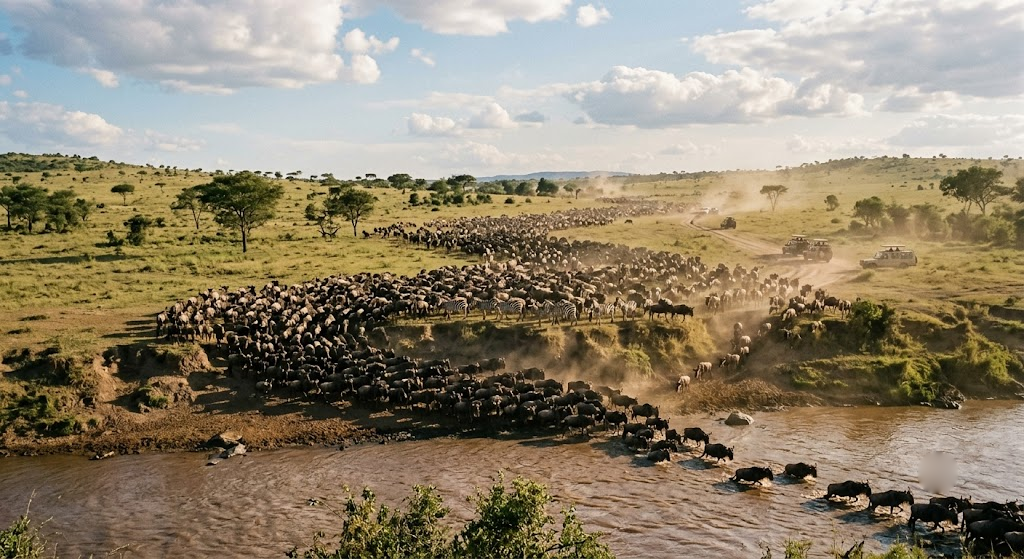
The scale is honestly hard to grasp until you've stood at a crossing point and watched it happen. Over 1.3 million wildebeest form the core of the herds, based on the ecosystem breakdown published by the Convention on Migratory Species, and that figure doesn't even count the zebras, gazelles, elands, and the odd giraffe or elephant that cross paths with the herds along the way. Predators trail the whole procession too. Lions, hyenas, cheetahs, and the crocodiles waiting in the Mara River all time their own behavior around this movement.
Which Ecosystem Do the Herds Move Through?
The Serengeti-Mara ecosystem spans roughly 30,000 square kilometers across Tanzania and Kenya, a transboundary protected range mapped out in detail by Google Arts & Culture. This isn't a single park. It stitches together the Serengeti National Park, the Ndutu plains, the Western Corridor toward Lake Victoria, and the Masai Mara National Reserve across the border in Kenya. No fences separate these zones in the ideal scenario, which is precisely the point. Wildebeest need open corridors, not boxed-in reserves.
What Triggers the Herds to Move?
Rainfall Patterns and Fresh Grazing
The short rains and long rains dictate almost everything. Wildebeest instinctively track thunderstorms from a distance, some researchers suspect they smell the moisture, and move toward fresh grazing before the grass has even fully sprouted. This is why the migration map shifts slightly year to year. A drought in the southern Serengeti pushes herds north earlier than usual. Heavy rain delays a river crossing by weeks.
Predator Pressure and Herd Instinct
Safety in numbers isn't a cliché here, it's survival math. A lone wildebeest wandering the grasslands is an easy meal. A herd of half a million moving together overwhelms predators through sheer volume, even though this same density creates the panic and chaos you see during crossing rivers, when frantic herds pile into the water regardless of the large crocodiles waiting below.
Water Availability Across the Circuit
Here's a statistic that stops people mid-sentence when I mention it on tours: if the Mara River stops flowing or access gets blocked for around ten days during peak dry season, over 100,000 wildebeest can die of thirst, according to the ecosystem thresholds outlined by the CMS fact sheet. Water isn't a convenience for these herds. It's the entire logic behind the route.
What Happens Month by Month in the Migration?
Period | Location | Key Activity |
|---|---|---|
December to March | Southern Serengeti, Ndutu plains | Calving season, up to 8,000-10,000 calves born daily |
April to June | Central Serengeti toward Western Corridor | Rut (mating), movement begins toward Grumeti River |
July to September | Western Serengeti into Masai Mara | Grumeti and Mara River crossings |
October to November | Loliondo, eastern Serengeti | Return journey south |
December to March: Calving Season in the Southern Serengeti
The short-grass plains around Ndutu and southern Serengeti National Park turn into a maternity ward every January through March, with daily calving rates climbing past 8,000 and occasionally over 10,000 newborns in a single day, per data from Wildebeest Sightings. This is deliberate timing, not coincidence. The volcanic soil in this region produces mineral-rich grass that lactating females need, and the sheer number of calves born within days of each other floods the area with vulnerable prey, which oddly protects the herd overall since predators simply can't eat them all.
April to June: The Move Toward Western Corridor
Once the plains dry out, herds start drifting northwest through central Serengeti. This is mating season, and the movement toward the Western Corridor sets up the first real geographic decision point of the year: whether herds swing toward the Grumeti River route or curve further toward Lake Victoria, a split documented in the cartographic breakdown from Tanzania Odyssey.
July to September: River Crossings Into the Mara
This is peak migration safari season, and for good reason. Herds funnel through the Western Serengeti, cross the Grumeti River, then push north into the Masai Mara ecosystem, tackling the Mara River itself along the way. September in the Masai Mara often delivers the most dramatic Mara River crossings of the entire year, with thousands of wildebeest plunging in at once.
October to November: Return South Through Loliondo
Rain patterns shift again, and the herds begin their long walk back south through Loliondo and eastern Serengeti, closing the loop before calving season restarts. It's less photographed, less crowded with vehicles, but arguably just as fascinating for travellers who prefer solitude over spectacle.
When Is the Best Time to See River Crossings?
Grumeti River Crossings Explained
Smaller and generally calmer than the Mara, Grumeti crossings happen from around May through July as herds move through the Western Corridor. Fewer crocodiles here, and honestly, fewer tourist vehicles too.
Mara River Crossings Explained
The famous one. Between July and September, herds attempt crossing rivers along the Mara multiple times, and here's something most first-time visitors don't expect: it's rarely a single clean crossing. Herds mill around the banks, cross, sometimes swim back, then cross again days later, a behavioral pattern confirmed by Africa Geographic's coverage of the Kenya-Tanzania crossing dynamics. Nile crocodiles wait in the deeper pools, and yes, the prey encounter rate is high enough that most safari-goers witness at least one kill if they stay a few days near a crossing point.
How to Predict Crossing Points
Nobody predicts this with total accuracy, not even researchers who've tracked the ecosystem for decades. What experienced guides do is watch herd density on the southern bank, monitor rainfall upstream, and communicate constantly across camps. Sightings from field teams like Sauti Africa Safaris and WildByLemah get shared in near real-time across operator networks, which is often more reliable than any published migration map.
Where Should You Go to Watch the Migration?
Southern Serengeti (Ndutu plains): Best January to March for calving season and predator activity around vulnerable calves.
Western Corridor: Best May to July for Grumeti River crossings with fewer crowds.
Mara Triangle and Northern Serengeti: Best July to September for the dramatic Mara River crossings that define most people's mental image of the great migration.
Each zone rewards a different kind of traveller. Ndutu suits photographers chasing newborn drama and cheetah action. The Mara Triangle suits anyone who wants the postcard chaos of wildebeest leaping into water.
Where Is the Migration Right Now?
How Migration Timing Shifts With Weather
Climate disruption has made this harder to pin down than it was even fifteen years ago. Erratic rainfall and intensified droughts are shrinking the window herds spend in the Masai Mara, according to reporting by Context News on climate risks facing the ecosystem, which means the old "September is crossing season" rule of thumb is loosening its grip. Some years the crossings start in late June. Other years they barely happen at all before herds turn back south early.
Reliable Sources for Live Herd Updates
Operators lean on the HerdTracker tool and ground reports from lodges scattered across both countries to give travellers fly-in advice with any real confidence. I'd treat any migration map you see online as a rough guide rather than gospel, updated weekly at best, and often lagging behind what guides are actually seeing on the ground that same morning.
How Do Fencing and Land Use Threaten the Migration?
This is the part safari brochures skip over. Expanding fencing, land subdivision around the Mara Group Ranches, and unprotected corridors like the Ikoma Open Area are fragmenting routes that herds have used for generations, a vulnerability mapped against 1970s baselines by researchers publishing through the International Academic Journal of innovation and leadership. Add to that the tension between luxury camp development and corridor preservation, plus overtourism concerns around vehicle density at popular river crossings, and you start to understand why conservationists keep pushing for buffer zones and transboundary cooperation rather than treating each reserve as an island.
Where Should You Stay for the Best Migration Views?
Pick your camp based on the month, not the brand name. A fixed lodge in the central Serengeti is wasted in July when the herds are two hundred kilometers north. Mobile tented camps that shift with the season, common across both the Mara ecosystem and southern Serengeti, tend to serve migration-focused travellers far better than permanent structures locked into one location.
What Follow-Up Questions Do Travelers Often Ask?
Most people ask whether they need to choose Kenya or Tanzania. Honestly, it depends on timing more than preference, since the same herds move between both countries throughout the year. Others ask about Nyerere National Park, which sits outside the migration ecosystem entirely and offers a completely different, non-migratory safari experience worth knowing before you book.
FAQ
Is the migration visible year-round? Yes, but the spectacle changes. Calving in the south, crossings in the north, quieter transit months in between.
Do wildebeest migrate the same route every year? Broadly yes, but exact timing and crossing points shift with rainfall.
Can climate change stop the migration entirely? Not likely, but it's already compressing timelines and shrinking the reliable window for crossings.
Conclusion
The Great Wildebeest Migration earns its place among the Seven New Wonders precisely because it refuses to sit still for anyone, tourists, researchers, or conservation planners alike. It's messy, occasionally brutal, and stitched together by rainfall nobody can fully control. That unpredictability is exactly why it still feels like a genuine wonder rather than a scheduled show.